Feb 12, 2026
Breitling vs Omega: The Ultimate Swiss Watch Showdown
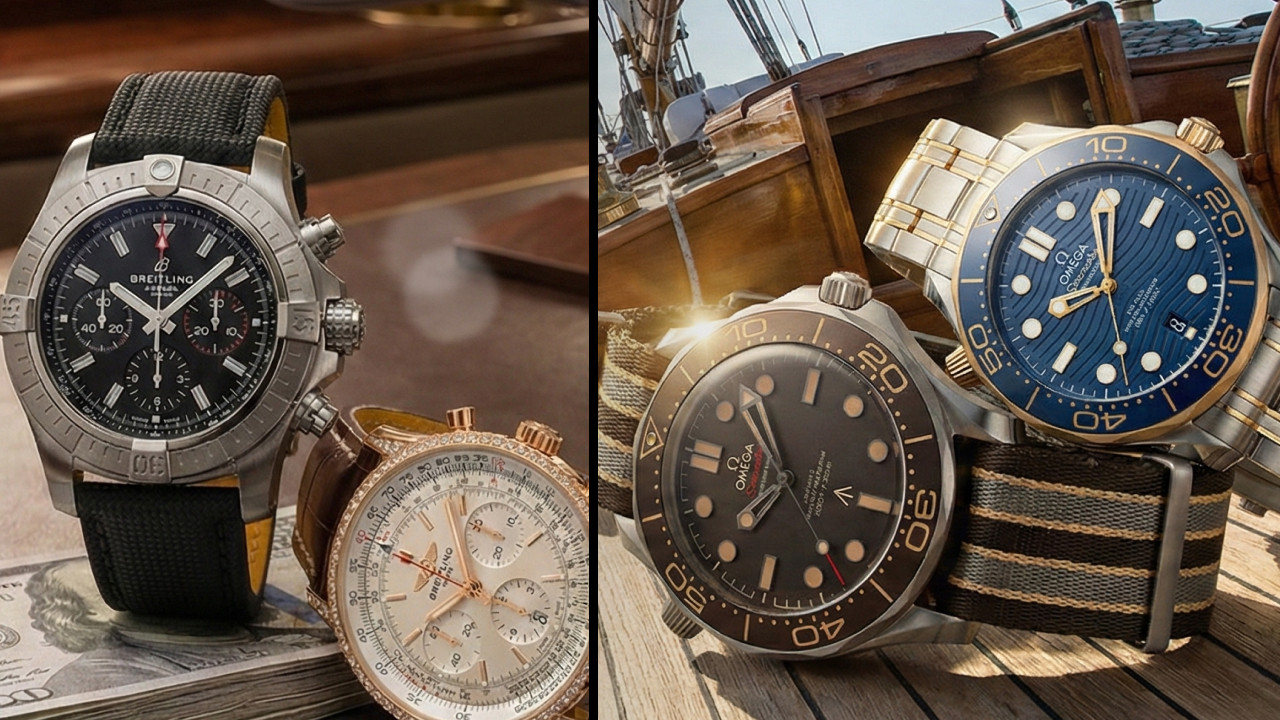
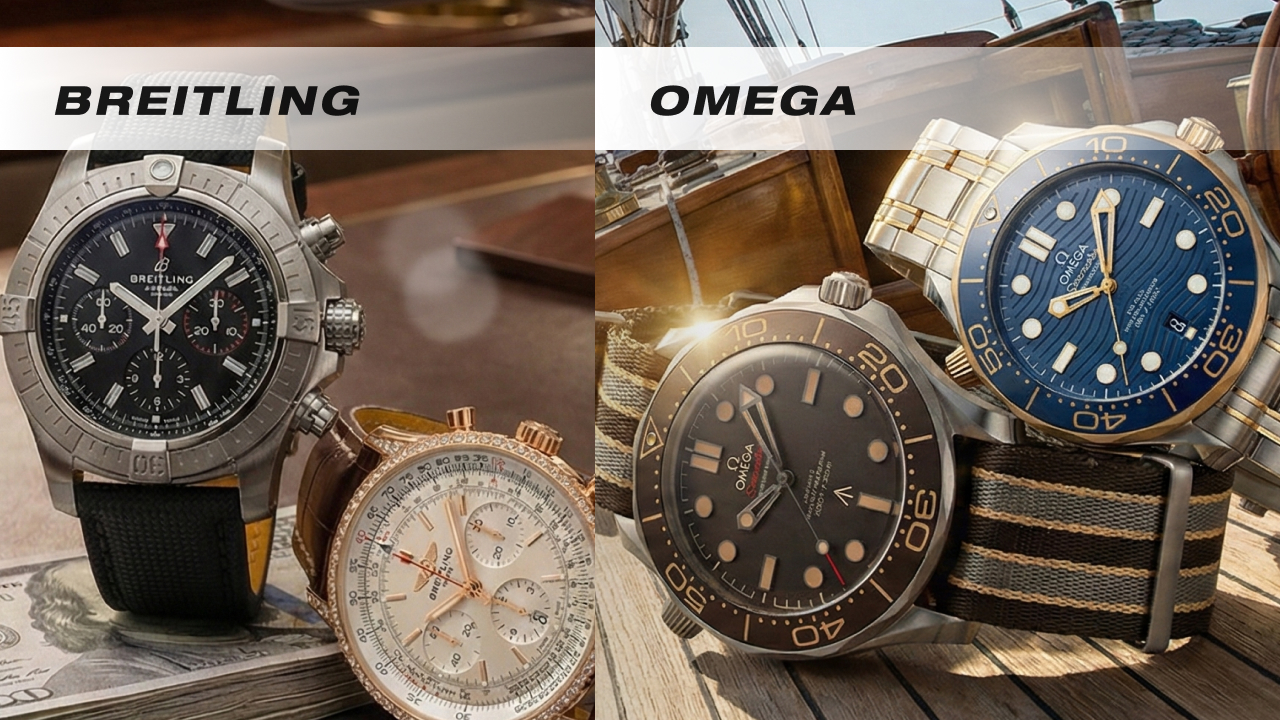
If you've found yourself torn between Breitling and Omega, congratulations—you've got excellent taste. You're standing at one of the most fascinating crossroads in Swiss watchmaking, where two legendary brands offer completely different philosophies wrapped in exceptional craftsmanship.
This isn't about which brand is "better." Both will outlive you, hold their value reasonably well, and make you feel like a million bucks every time you glance at your wrist. The real question is: which one is better for you?
The Heritage: Two Legendary Paths
Omega: When Space Met Style
Omega's story is the stuff of horological legend. Founded in 1848, they spent over a century perfecting their craft before achieving what every watchmaker dreams of: their timepieces went to the moon.
When Neil Armstrong stepped onto lunar soil in 1969, an Omega Speedmaster was strapped to his wrist. What our customers don't always realize is that NASA didn't choose it for marketing reasons—they subjected dozens of watches to brutal testing protocols, and the Speedmaster was the only one that survived everything they threw at it. That's genuine engineering credibility, not marketing spin.
But Omega didn't stop there. They've been official timekeepers for the Olympics since 1932, developing precision timing technology that revolutionized sports. And in one of the smartest brand partnerships in history, they became James Bond's watch in 1995. Since Pierce Brosnan strapped on that Seamaster in GoldenEye, every 007 film has featured Omega prominently.
The result? Omega built a brand that appeals to engineers, athletes, and style-conscious professionals simultaneously—a rare combination that explains why they command such strong resale values.
Breitling: Born in the Cockpit
Breitling took a different path, and frankly, our aviation enthusiast customers find it even more compelling. Since 1884, Breitling has been laser-focused on making precision instruments for people whose lives depend on accurate timing.
In 1915, they invented the modern chronograph push-piece—the button you press to start and stop a stopwatch function. It sounds simple now, but it revolutionized how pilots could operate timing functions while wearing gloves in freezing cockpits. In 1952, they launched the Navitimer, featuring a built-in slide rule that pilots could use to calculate fuel consumption, rate of climb, and flight times. It wasn't just a watch; it was a wearable flight computer decades before digital technology existed.
What impresses our team: Breitling's aviation connection isn't marketing—it's their DNA. Walk into any vintage aircraft cockpit, and you'll see Breitling instruments on the panel. Their watches look the way they do because they're designed to be read in a vibrating cockpit while pulling G-forces.
Design Philosophy: Versatility vs. Bold Presence
This is where customers' preferences typically crystallize in our showroom, because it's really about personal style and how you want to present yourself.
Omega: The Versatility Advantage
One thing our team at WatchWarehouse consistently observes: Omega makes watches that work in virtually any situation. That's their superpower.
The Seamaster transitions seamlessly from board meetings to beach vacations. The Speedmaster looks equally appropriate with a tailored suit or weekend jeans. Even their dressier Constellation models have enough sporty DNA that they never feel overly formal.
What this means for our customers: if you're building a collection and can only afford one luxury piece right now, Omega's versatility delivers incredible value. Their designs favor refinement—clean dials, elegant proportions, and thoughtful details that reveal themselves over time rather than demanding immediate attention. Case sizes typically run 39-43mm, making them wearable for a much wider range of wrist sizes.
The potential drawback? Some enthusiasts find them almost too versatile—handsome but perhaps not distinctive enough to make a bold style statement. If you want your watch to be an immediate conversation starter, Omega's refined subtlety might not deliver that impact.
Breitling: Maximum Wrist Presence
Breitling doesn't do subtle, and their fans wouldn't have it any other way.
We're talking 44-46mm cases (sometimes even larger), complex dials with multiple sub-registers, prominent bezels, and substantial wrist presence. When you wear a Navitimer, people notice. The busy dial layout with its signature slide-rule bezel isn't for everyone, but enthusiasts love that it looks like a precision instrument, not jewelry.
This is entirely intentional. Breitling's design language screams "tool watch"—something built for a specific professional purpose, where form follows function. Aviation details are everywhere: high-contrast markers for cockpit readability, chronograph pushers designed to operate with gloved hands, and bezels that rotate with satisfying mechanical clicks.
The tradeoff? These watches have a specific aesthetic. A Navitimer can work with a suit if you own it with confidence, but it'll never be as seamless as a Seamaster. And our team always cautions smaller-wristed customers (under 7 inches): many Breitling models will simply wear too large and overwhelm your wrist.
But here's what we've learned: Breitling buyers see this as a feature, not a limitation. They want that wrist presence. They want the tool-watch aesthetic. If that resonates with you, no other brand executes it quite like Breitling.
The Head-to-Head: Models You're Actually Considering
Let's compare the specific watches our customers typically debate.
Dive Watches: Seamaster vs. Superocean
The Omega Seamaster Diver 300M is one of the most successful luxury watches ever made, and our team has sold hundreds of them. It's been in continuous production since 1993, and the current version represents decades of refinement.
What makes it special? That wave-pattern dial is instantly recognizable and never gets old. The bracelet tapers beautifully and wears comfortably all day. At 42mm, it delivers substance without overwhelming your wrist. The helium escape valve at 10 o'clock is a legitimate feature for saturation diving, not merely decoration. And Omega's Co-Axial movement technology offers genuine technical advantages we'll discuss shortly.
The Seamaster works as a true daily watch. Customers wear them with everything, and they never feel out of place. That versatility commands a premium: prices start around $5,800 and climb past $9,000 for precious metal versions.
The Breitling Superocean takes a more overtly sporty approach. It's bolder, with more aggressive colors and a more muscular case design. Some models offer water resistance up to 1,000 meters versus the Seamaster's 300—which matters if you're doing serious technical diving (though let's be honest, 300 meters is already massive overkill for recreational diving).
The Superocean's secret weapon? Outstanding value. At WatchWarehouse, we offer these starting around $4,000-$5,000, which is remarkable pricing for a Swiss dive watch with COSC-certified chronometer accuracy. Yes, the Seamaster carries more prestige and holds value better at resale, but if your priority is getting the most watch for your money, the Superocean absolutely delivers.
Our verdict: The Seamaster is the more prestigious, versatile choice with superior resale value. The Superocean offers exceptional value and more serious diving credentials. Both are excellent—your choice depends on whether you prioritize versatility and prestige (Seamaster) or value and purpose-built capability (Superocean).
Chronographs: The Legends Face Off
This is where both brands bring their absolute A-game.
The Omega Speedmaster Professional—the Moonwatch—is arguably the most important chronograph ever made. Our team loves showing customers this piece because it's essentially unchanged since 1969, and there's a reason: the design is perfect.
Clean, beautifully balanced dial. Hand-wound movement. Hesalite crystal that can be polished if scratched. At around $6,500, it represents shocking value when you consider you're buying an actual piece of space history. Our customers consistently mention the Speedmaster as one of their best purchases.
What surprises people: the Speedmaster wears smaller than expected. The 42mm case sits flat on the wrist, and the manual-wind movement keeps it relatively thin at under 14mm. It's not flashy—some even call it understated—but that timeless elegance and historical significance make it incredibly compelling. Plus, vintage Speedmasters have appreciated significantly, making modern references one of the safer luxury watch investments.
The Breitling Navitimer offers the polar opposite experience. This is a watch that demands attention with its slide-rule bezel, multiple sub-dials, and complex dial architecture. It's busier, larger (typically 43-46mm), and makes zero attempt at subtlety.
But here's what Navitimer owners tell our team: once you understand the slide rule and appreciate the aviation heritage, the complexity becomes purposeful rather than cluttered. This is an authentic pilot's tool, and wearing one connects you to decades of aviation history in a way few other watches can. Modern versions use in-house automatic movements, and while they're pricier at $8,000-$10,000, you're getting serious manufacture movement complexity.
Our recommendation: If you want a chronograph that's become a cultural icon, works everywhere, and represents a smart investment, choose the Speedmaster. If aviation history genuinely speaks to you and you appreciate functional complexity over minimalism, the Navitimer is one of the most distinctive timepieces money can buy.
The Technology: What's Actually Inside
Let's discuss what's ticking inside these watches, because this is where Omega has genuinely pulled ahead in recent years.
Omega's Technical Innovation
Omega didn't just coast on heritage—they invested heavily in movement technology. Their Co-Axial escapement, developed with legendary watchmaker George Daniels, reduces friction in the movement, theoretically extending service intervals and improving long-term accuracy.
But the real game-changer is their Master Chronometer certification. Every modern Omega movement resists magnetic fields up to 15,000 gauss. Our team emphasizes this to customers because it matters in real-world use. We live surrounded by electronics—laptops, phones, magnetic bag clasps—and magnetic fields are the silent killer of mechanical watch accuracy.
Omega solved this with proprietary silicon components and clever engineering. It's tested by METAS (the Swiss Federal Institute of Metrology), which maintains stricter standards than standard COSC chronometer certification. This represents genuine innovation that improves daily performance.
Breitling's Solid Craftsmanship
Breitling takes a more traditional approach, and there's nothing wrong with that. They offer COSC-certified chronometers that guarantee accuracy within -4/+6 seconds per day—excellent by any standard, just not quite as strict as Omega's Master Chronometer specification.
Where Breitling has invested significantly is in manufacturing capability. They've brought movement production in-house, developing their own calibers rather than relying on third-party suppliers. Their Manufacture Caliber B01, for instance, is a column-wheel chronograph movement with 70-hour power reserve—a genuine horological achievement that watch enthusiasts respect.
Breitling movements are robust, reliable, and beautifully finished if you flip the watch over. They're not breaking new ground like Omega's anti-magnetic technology, but they're executing traditional Swiss watchmaking at a very high level.
The bottom line: On paper, Omega's anti-magnetic technology and stricter certification give them the technical edge. In practice, both brands make movements that will run accurately for decades with proper service. Unless you work in an MRI facility, you probably won't notice the practical difference day-to-day.
Pricing and Value: What You'll Actually Spend
Let's talk real numbers, because our team at WatchWarehouse believes in transparency.
Entry-Level Investment
Want to enter Swiss luxury watchmaking? Breitling offers the more accessible entry point. At WatchWarehouse, we offer Superocean automatics starting around $3,500-$4,000—remarkable value for a COSC-certified Swiss timepiece from a legitimate manufacture.
Omega's entry point sits higher, around $5,000-$6,000 for a Seamaster Aqua Terra. You're paying a premium for brand prestige, but you're also getting Master Chronometer certification and arguably more versatile styling.
The Sweet Spot: $6,000-$10,000
Both brands absolutely shine in this range, and it's where our team sees the most customer interest. This is where you find the icons: the Speedmaster Professional, the Seamaster Diver 300M, the Navitimer, the Superocean Heritage. At this price point, you're getting in-house movements, excellent finishing, and watches that will genuinely last generations.
This is also where value becomes compelling. A Speedmaster at $6,500 delivers incredible return when you consider its heritage and movement quality. A Navitimer at $9,000 gives you genuine manufacture movement complexity. Both feel like smart purchases rather than pure luxury indulgences.
Investment and Resale Considerations
Here's the honest truth our team shares with every customer: most watches depreciate the moment you walk out of an authorized dealer. But some hold value significantly better than others.
Omega, particularly the Speedmaster Professional, has proven itself as a relatively safe watch investment. Vintage Speedmasters have appreciated substantially, and even modern references hold 60-80% of their retail value on the secondary market. Seamasters also hold value reasonably well, especially limited editions tied to James Bond films.
Breitling has historically depreciated more—often 40-50% immediately after purchase. However, this has improved dramatically in recent years as the brand has focused on quality over quantity. Vintage Navitimers are appreciating, and modern limited editions hold value much better than standard production models.
Reality check: Unless you're buying vintage or ultra-limited pieces, think of your watch purchase as buying something to enjoy, not primarily as an investment. Yes, Omega will likely hold value better, but neither should be purchased solely for financial returns.
Making Your Decision: Which Brand Is Right for You?
After helping thousands of customers through this decision, our team at WatchWarehouse has identified clear patterns in who gravitates toward each brand.
Choose Omega If...
You want maximum versatility. If you're building a collection and can only afford one luxury piece right now, Omega's ability to work in any situation delivers incredible practical value. Customers wear Seamasters and Speedmasters with suits on Monday and casual wear on Saturday without any disconnect.
Brand recognition matters. Your colleagues, clients, and friends are more likely to recognize and respect an Omega. The James Bond connection and moon landing heritage provide instant credibility.
Resale value is a consideration. If you might want to sell or trade this watch in 5-10 years, Omega's stronger secondary market provides a real financial advantage.
You appreciate refined design. If you prefer watches that don't demand attention, Omega's cleaner aesthetics age gracefully and never feel dated.
Choose Breitling If...
You want maximum wrist presence. If "subtle" isn't in your vocabulary and you love watches that make bold statements, Breitling delivers design impact like few other brands.
Aviation history genuinely excites you. If you're a pilot, aviation enthusiast, or simply love the aesthetic of cockpit instruments, Breitling's authentic aviation heritage is unmatched in the industry.
Value per dollar matters more than prestige. Breitling often gives you more watch for less money—more features, more complications, more presence for your investment. At WatchWarehouse, our competitive pricing makes Breitling an especially compelling value.
You're drawn to purpose-built tool watches. If you appreciate watches designed for specific professional applications rather than versatile luxury pieces, Breitling's focused philosophy will resonate.
Our Team's Recommendations by Scenario
Here's what we at WatchWarehouse actually recommend based on thousands of customer interactions:
Your first luxury watch: Get the Omega Seamaster. Its versatility means you won't outgrow it as your taste evolves, and the brand recognition gives you credibility as you explore the watch world.
You're a chronograph enthusiast: The Speedmaster Professional is virtually a no-brainer. Heritage, value, and collectibility converge in one exceptional package.
You're a pilot or aviation fan: The Navitimer isn't just appropriate—it's the most authentic choice. Own your passion with the watch that defined the category.
Budget is a constraint but quality can't be compromised: The Breitling Superocean delivers Swiss quality and COSC certification at prices that make competitors look overpriced. At WatchWarehouse, we offer some of the best pricing on Superocean models.
This is an investment piece: The Speedmaster Professional has the strongest track record for holding and appreciating in value over time.
Why Choose WatchWarehouse?
Our team at WatchWarehouse has built our reputation on three pillars: competitive pricing, exceptional customer service, and genuine expertise. We don't just sell watches—we help customers make informed decisions they'll feel great about for years.
With outstanding customer reviews and some of the best prices in the industry, we've become the trusted choice for luxury watch buyers who want both value and expertise. Whether you're leaning toward Omega's refined versatility or Breitling's bold character, our team is here to guide you through every detail.
Browse our collection of Omega and Breitling timepieces on our website, where you'll find detailed specifications, high-resolution images, and transparent pricing. Have questions? Our watch specialists are always available to provide personalized guidance based on your specific needs and preferences.
Final Thoughts
After years in this business and countless customer conversations, here's what our team at WatchWarehouse knows for certain: there's no wrong choice between Omega and Breitling. Both brands produce exceptional timepieces that will outlast you and potentially become cherished family heirlooms.
The real question isn't which brand is objectively better—it's which one speaks to your personal style and values. Do you see yourself as someone who values versatility and refined elegance, or someone who appreciates bold character and purposeful design? Do you want the watch James Bond wears, or the watch Chuck Yeager wore?
Ultimately, the best watch isn't the one with the best specifications, the strongest resale value, or the most prestigious heritage. It's the one that makes you smile every single time you check the time. Both Omega and Breitling can deliver that feeling—just in distinctly different ways.