Posted by Watch Warehouse on Aug 19, 2026
Iconic Watch Designs: A History of Timeless Style
Have you ever wondered why certain watch designs feel instantly familiar, even to people who have never owned a mechanical timepiece? A diver's watch with its rotating bezel, a field watch with clean numerals, a chronograph with its busy dials—these shapes have become part of our visual language. They didn't arrive fully formed. Each one evolved to solve a real problem, and the ones that endured did so because they balanced function, proportion, and a kind of quiet elegance that never quite goes out of style.
Understanding the history behind these famous watch designs is more than trivia. It helps you appreciate what you're wearing, and it makes you a smarter buyer. When you know why a design exists, you can tell the difference between a watch built on genuine heritage and one merely dressed up to look the part. Let's walk through some of the most influential design archetypes and explore what made them last.
Why Do Some Watch Designs Become Timeless?
The watches we now call iconic almost always began as tools. Before the wristwatch was a fashion statement, it was equipment—for pilots navigating without GPS, for soldiers coordinating maneuvers, for divers who needed to track their oxygen underwater. Form followed function so closely that the resulting designs carried an honesty that people still respond to today.
Timelessness, then, isn't about being fashionable. It's about restraint. The most enduring classic watch styles share a certain discipline: legible dials, balanced proportions, and details that serve a purpose rather than decorate for its own sake. When a design earns its features rather than borrowing them, it tends to age gracefully. That's why a well-made field watch from the 1940s can still look completely at home on a wrist in 2025.
There's also an element of cultural memory. Once a design becomes associated with a moment—a moon landing, a racing circuit, a deep-sea expedition—it accumulates meaning that pure aesthetics can't replicate. That story becomes part of the object, and part of why we keep coming back to it.
The Dive Watch: Function That Became a Fashion Statement
Few designs have traveled as far from their origins as the dive watch. Born in the early 1950s to serve professional and recreational divers, the archetype is immediately recognizable: a robust case, a screw-down crown for water resistance, luminous markers for low-light visibility, and above all, that unidirectional rotating bezel. The bezel wasn't a styling flourish—it let a diver track elapsed time underwater, and its one-way rotation meant an accidental bump could only shorten the perceived remaining time, never dangerously extend it.
What's fascinating is how thoroughly the dive watch escaped the water. Today, the overwhelming majority of dive watches never go deeper than a swimming pool, yet the design endures because it reads as capable, sporty, and versatile. A matte black dial with a rotating bezel pairs as easily with a suit as it does with weekend attire, which is precisely why so many brands interpret the template in their own way.

Gucci watches
GUCCI Dive 45MM SS BLK Matte Dial Rotating Bezel Men's Watch YA136208A
The Gucci Dive above is a good example of how a fashion house can honor the dive-watch language while adding its own signature. It carries all the recognizable cues—the 45mm stainless steel case, the matte black dial, the rotating bezel—but wears them with a design sensibility that leans more toward style than saturation diving. That's a legitimate approach, and it speaks to how flexible the template has become. If you're drawn to the sporty silhouette but spend most of your time on land, a design like this delivers the look without demanding professional-grade specifications you'll never use.
The Field Watch: Born From Necessity, Refined by Simplicity
If the dive watch is about capability, the field watch is about clarity. Its lineage traces back to military timepieces designed for the trenches and battlefields of the twentieth century, where a soldier needed to read the time instantly, in poor conditions, without a second thought. Everything about the design supports that goal: high-contrast dials, oversized Arabic numerals, and often a secondary 24-hour scale for coordinating with military time.
What I love about the field watch is its honesty. There's nothing decorative about it—every element earns its place. That's exactly why it has become one of the most beloved iconic watches among enthusiasts who value substance over flash. A good field watch is the antithesis of ostentation. It's a tool that happens to be beautiful precisely because it refuses to try too hard.
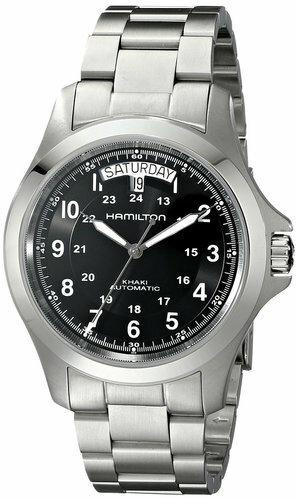
Hamilton has a genuine claim to this heritage—the brand supplied timepieces to the U.S. military during the World War II era, and its Khaki Field line draws directly from that history. The Khaki Field King shown here adds a day-date complication to the classic formula and runs on an automatic movement, which means it winds itself through the motion of your wrist. It's a thoughtful example of how a heritage design can evolve without losing its identity. At its price point, it also represents one of the more accessible entry points into mechanical watches with authentic historical roots, which is part of why it earns such loyalty among newcomers and seasoned collectors alike.
The Chronograph: When Watches Learned to Measure More Than Time
The chronograph is where horology gets ambitious. At its core, it's a watch with a built-in stopwatch, allowing you to measure elapsed intervals independently of the running time. That may sound simple, but the mechanics behind a chronograph are among the most intricate a traditional watchmaker can tackle, involving pushers, clutches, and column wheels working in precise coordination.
The design became inseparable from motorsport in the mid-twentieth century. Racing demanded precise timing, and the chronograph delivered—often paired with a tachymeter scale on the bezel that let a driver calculate average speed over a measured distance. That association gave chronographs a distinctly energetic character: multiple sub-dials, prominent pushers flanking the crown, and a sense of purpose that reads as dynamic even at a glance. Among classic watch styles, few carry as much visual drama.

TAG Heuer Watches
TAG HEUER Carrera Calibre-16 43MM Day-Date Leather Men's Watch CV2A1R.FC6235
The TAG Heuer Carrera is one of the definitive racing chronographs, and it wears its heritage proudly. Introduced in the 1960s, the Carrera was conceived specifically for professional drivers who needed a legible, uncluttered dial they could read at speed. The Calibre 16 version pictured here carries that legacy forward with a 43mm case, an automatic chronograph movement, a day-date display, and a leather strap that softens its sporting edge into something you could wear to the office. It sits at a higher price point than the field and dive watches we've discussed, which reflects the added complexity of a mechanical chronograph and the depth of the Carrera's storied lineage.
How Should You Choose Among These Iconic Designs?
Once you understand the origins of these archetypes, choosing between them becomes less about which is "best" and more about which fits your life. A dive watch rewards those who want versatility and a sporty presence. A field watch suits people who value understatement and legibility above all. A chronograph appeals to those drawn to mechanical complexity and a bit of visual energy. None is objectively superior—they simply solve different problems and express different personalities.
It's worth being honest about the tradeoffs, too. A larger 45mm dive case makes a bold statement but may overwhelm a smaller wrist. A chronograph offers fascinating functionality, but most owners rarely use the stopwatch, and the added complexity means more to service over the years. A field watch's simplicity is a virtue for daily wear, though it may feel too casual for formal occasions. The right choice depends on how you actually live, not on which design happens to be trending.
My practical advice is to think about the version of yourself you want your watch to reflect, then let the history guide you toward something authentic. A design carries meaning because it earned it over decades. When you wear a genuine dive, field, or racing chronograph, you're participating in that continuity—and that connection tends to bring more lasting satisfaction than any passing trend ever could.
The Enduring Value of Understanding What You Wear
The most rewarding part of exploring famous watch designs is realizing that the shapes we take for granted were once radical solutions to genuine challenges. That rotating bezel, that high-contrast dial, those chronograph pushers—each represents a small triumph of design thinking that has quietly outlasted the problems it was created to solve. Learning this history transforms how you look at every watch you encounter.
If you're considering adding one of these classics to your own collection, it helps to work with people who understand the stories behind them. At Watch Warehouse, our decades of experience mean we can help you find not just a watch, but the right watch—one whose heritage genuinely resonates with how you live and what you value. Take your time, learn the history, and let that knowledge lead you to a timepiece you'll be glad to wear for years to come.
Featured Watches to Consider
Here are some examples from the Watch Warehouse collection that illustrate the points discussed above:
Gucci watches
GUCCI Dive 45MM SS BLK Matte Dial Rotating Bezel Men's Watch YA136208A
TAG Heuer Watches