Posted by Watch Warehouse on Jul 15, 2026
Watch Water Resistance Explained: What the Numbers Really Mean
Few specifications on a watch generate more confusion, and more accidental damage, than water resistance. You've probably seen the numbers stamped on a caseback: 30 meters, 50 meters, 100 meters, or those cryptic "ATM" markings. It seems straightforward enough. A watch rated to 30 meters should survive a swim in the pool, right? As it turns out, that logic has ruined more timepieces than almost any other misunderstanding in the hobby.
The truth is that water resistance ratings don't mean what most people intuitively assume, and understanding the gap between the marketing number and real-world performance can save you an expensive repair. Let's walk through how these ratings actually work, what the ATM figures really represent, and how to make sensible decisions about wearing your watch around water.
What Does the ATM Rating on a Watch Actually Mean?
The abbreviation ATM stands for "atmospheres," a unit of pressure. One atmosphere is roughly the pressure exerted by the air at sea level, and it's also approximately equivalent to the pressure of ten meters of water depth. So a watch rated at 10 ATM is theoretically tested to withstand 100 meters of water pressure. This is why you'll see the two labeling systems used interchangeably: 5 ATM equals 50 meters, 10 ATM equals 100 meters, and so on.
Here's the crucial catch. These ratings are derived from static pressure tests conducted in a laboratory, where the watch sits motionless in a pressurized chamber. Real water activity is dynamic. When you swim, dive off a board, or even just move your arm forcefully through water, the momentary pressure spikes can far exceed the static equivalent of your actual depth. A swimmer's stroke can generate pressure that briefly mimics being several meters deeper than they really are.
This is the single most important concept in understanding water resistance: the depth rating is not a measure of how deep you can go, but of the pressure the watch resisted under controlled conditions. It's a benchmark, not a promise about your specific activities.
Breaking Down the Common Ratings
A watch marked 30 meters (3 ATM) is, despite the number, not suitable for swimming at all. This rating means the watch can handle incidental splashes, rain, or hand washing. Submerging it, even briefly in a shallow pool, risks pushing water past the seals. Many dress watches carry this rating, and that's perfectly appropriate for their intended use.
At 50 meters (5 ATM), you gain a bit more security. You can generally wear the watch in the shower or during light swimming where you're not diving or generating significant force. Still, this isn't a rating built for serious aquatic activity, and repeated exposure will test the seals over time.
A rating of 100 meters (10 ATM) is where a watch becomes genuinely swim-friendly. You can swim laps, snorkel, and enjoy recreational water activities with confidence. This is often considered the practical minimum for anyone who wants a watch that lives comfortably around water without constant worry.
Beyond that, 200 meters (20 ATM) and higher move into true dive territory. Watches at these levels are engineered with screw-down crowns, thicker crystals, and robust gaskets to handle scuba diving and the demands of professional use. The internationally recognized ISO 6425 standard defines what qualifies as a genuine "diver's watch," which includes far more rigorous testing than a simple depth marking.
The Sport Watch That Handles Real Water
When people ask about a watch that can truly go swimming without hesitation, dive-oriented models are the obvious answer. Consider something like the Gucci Dive, a 45mm stainless steel piece with a unidirectional rotating bezel and a robust case built for aquatic use. The rotating bezel isn't just a design flourish; on genuine dive watches it serves to track elapsed time underwater, and its presence signals a watch designed with water performance in mind.

Gucci watches
GUCCI Dive 45MM SS BLK Matte Dial Rotating Bezel Men's Watch YA136208A
A watch like this exists in a different category from a dress piece. The higher water rating, the screw-down elements, and the overall construction are all designed so that you don't have to think twice before jumping in. That peace of mind is precisely what you're paying for when you choose a dive-style watch, even if you never actually strap on a tank and descend to depth.
What About Field Watches and Everyday Automatics?
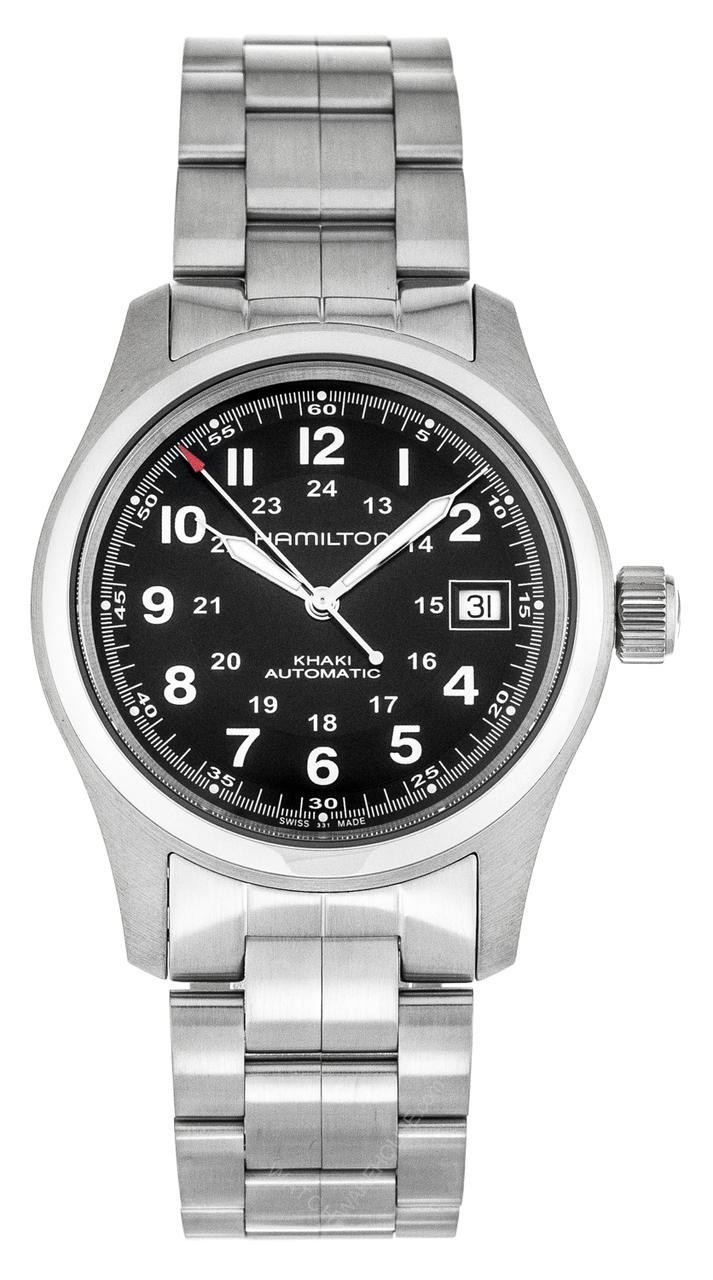
Not every watch needs to be a dive watch, and that's an important thing to understand. A field watch, for instance, is designed around a different set of priorities: legibility, ruggedness against knocks and dust, and reliable timekeeping in outdoor conditions. Water resistance is present but usually modest. Take the Hamilton Khaki Field, a 38mm automatic with a clean black dial rooted in genuine military watch heritage.
Hamilton watches
Hamilton Khaki Field 38MM Black Dial Automatic Men's Watch H70455133
A field watch will happily survive rain, sweat, and the occasional splash, but it isn't the tool you'd choose for lap swimming. Understanding this distinction helps you match the watch to the life you actually live. If your days involve trails, travel, and general wear, a modest rating is perfectly adequate. The mistake is expecting a versatile everyday automatic to perform like a purpose-built diver simply because it happens to have some water resistance.
Can You Swim With a Dress Watch?
The short answer is that you generally shouldn't. Dress watches prioritize elegance and slimness, which often means simpler case construction and lower water ratings. A refined automatic like the Tissot T-Classic Le Locle is a beautiful example of the genre, with its classic proportions and traditional styling meant for the office, dinners, and formal occasions.

A watch like this will comfortably handle a splash of rain or a quick hand wash, but it was never intended to be submerged. Wearing it to the pool would be asking it to perform a job it wasn't designed for. The good news is that a well-chosen collection often includes different watches for different purposes: a dress piece for formal wear, and a sportier model when water is involved.
Why Water Resistance Degrades Over Time
Here's something many owners never consider: water resistance is not permanent. The seals and gaskets that keep water out are made of rubber and similar materials that dry out, compress, and degrade with age, heat exposure, and chemical contact. A watch that was genuinely water resistant when you bought it may not be five years later, even if it looks perfectly fine.
This is why chlorine, saltwater, soaps, and sunscreens deserve caution. Chlorine and salt can corrode gaskets and metal components, while temperature swings, like jumping into a cold pool on a hot day or wearing your watch in a hot shower or sauna, cause materials to expand and contract in ways that stress the seals. If you regularly swim with your watch, having its water resistance tested periodically, typically every one to two years, is a sensible practice.
One more critical rule: never operate the crown or pushers underwater or when the watch is wet. On watches with a screw-down crown, always confirm it's fully screwed in before any water contact. An unscrewed or partially pulled crown creates a direct channel for water to enter the movement, and this is one of the most common causes of water damage we see.
Making the Right Choice for Your Life
The best approach isn't to chase the highest possible water rating, but to honestly assess how you'll use the watch. If you swim regularly, snorkel on vacation, or simply want the freedom never to think about water, a model rated to 100 meters or more is the sensible floor. If your watch primarily accompanies you to the office and out to dinner, a lower rating is entirely appropriate, and you'll be rewarded with a slimmer, more elegant case.
What matters most is understanding what your specific watch is built to do, and respecting those limits. A little knowledge here goes a long way toward protecting an investment you'll hopefully enjoy for decades. If you're weighing options and want guidance matched to your lifestyle, the team at Watch Warehouse has spent more than 25 years helping people find timepieces that suit how they actually live, water and all.
Ultimately, water resistance is less about the number on the caseback and more about matching the right tool to the right task. Learn what your watch can handle, keep its seals maintained, and treat the rating as a guideline rather than a dare. Do that, and your watch will be ready for whatever your day brings.
Featured Watches to Consider
Here are some examples from the Watch Warehouse collection that illustrate the points discussed above:
Gucci watches
GUCCI Dive 45MM SS BLK Matte Dial Rotating Bezel Men's Watch YA136208A
Hamilton watches